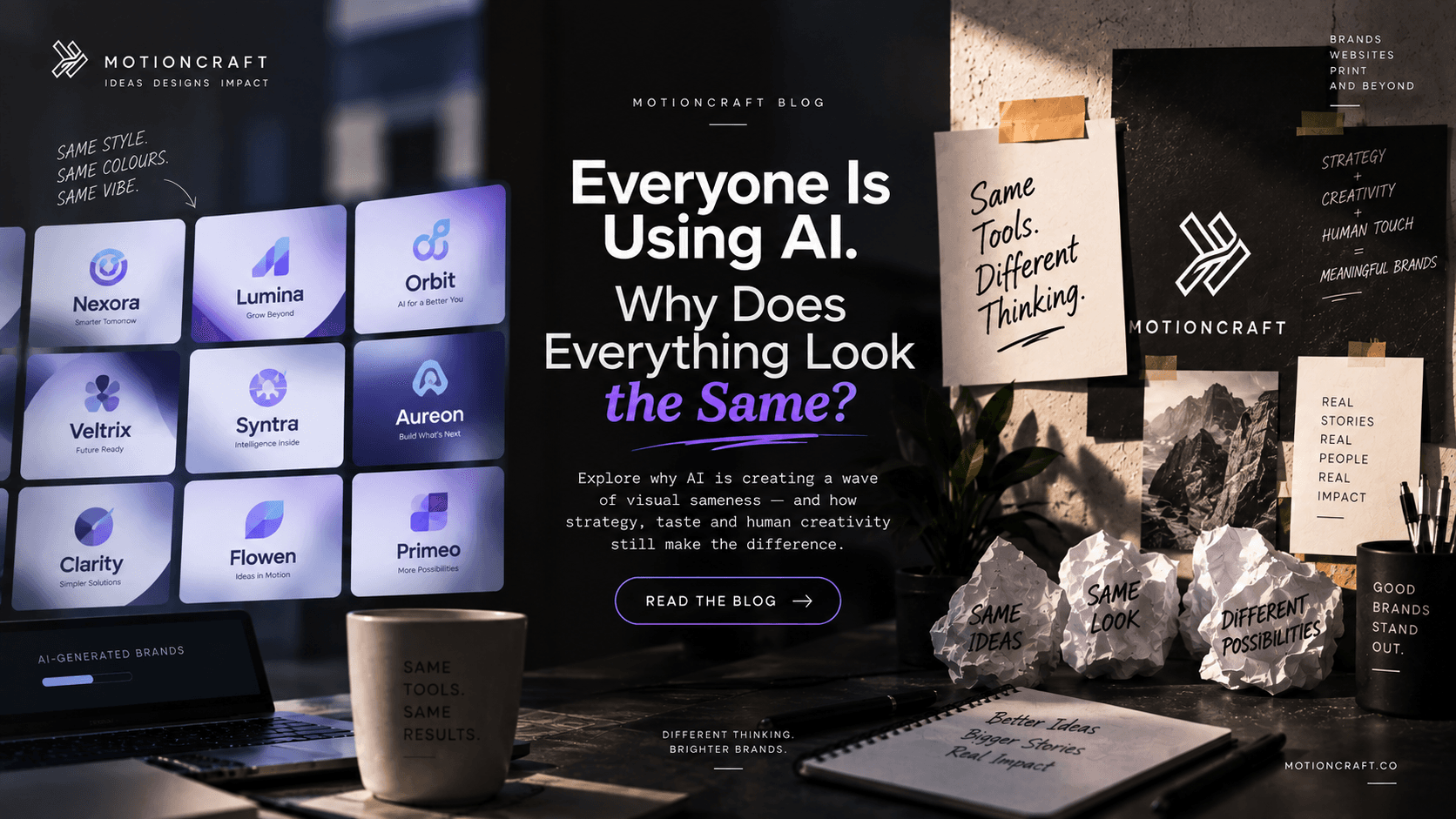
Everyone Is Using AI. Why Does Everything Look the Same?
SEO title: Why AI-Generated Design Looks the Same — and How Brands Can Stand Out
Primary keyword: AI-generated design
Related keywords: AI design, AI graphic design, AI-generated content, AI branding, AI art, creative direction, AI design tools, brand differentiation, AI marketing
Meta description: AI design tools have made visual creation faster than ever. So why does so much AI-generated content look alike? The answer is creative direction, taste and originality.
We have more creative tools than at any point in history.
And somehow...
everything is starting to look suspiciously familiar.
Perfectly lit portraits.
Blue-purple gradients.
Glass objects.
Cinematic offices.
Floating 3D shapes.
Perfect skin.
Perfect products.
Perfectly generic startups.
AI hasn't reduced creativity.
But it has created an enormous amount of competent visual output.
And competence is no longer enough to stand out.
The problem is creative convergence
Give thousands of people:
Similar tools.
Similar references.
Similar prompts.
Similar trend inspiration.
Similar algorithms.
You shouldn't be surprised when some outputs begin to converge.
This isn't unique to AI.
Design has always had trends.
But generative AI dramatically increases the speed at which visual styles can be reproduced.
A visual direction becomes popular.
People prompt it.
Others see those results.
They prompt similar results.
The cycle accelerates.
AI isn't making everything the same
We are.
AI can produce extraordinary variety.
But prompts often begin with phrases such as:
"Modern."
"Premium."
"Minimal."
"Cinematic."
"Luxury."
"Futuristic."
The model then has to interpret what those incredibly broad ideas mean.
Unsurprisingly, it often returns familiar visual conventions.
The solution isn't necessarily a better model.
It's better direction.
Creative direction is becoming a competitive advantage
Canva's 2026 marketing research explicitly identifies direction as a differentiator in an environment where AI makes content generation dramatically easier. Its research argues that taste, judgment and cultural insight increasingly separate impactful work from background noise.
That's significant.
The valuable skill is moving from:
"Can you make this?"
toward:
"Should we make this?"
and:
"How should this specifically belong to our brand?"
Taste cannot simply mean "what I like"
Professional creative judgment isn't:
"I prefer version three."
It's:
"Version three supports our positioning because..."
That's different.
Creative direction considers:
Audience.
Culture.
Competition.
Strategy.
Context.
Brand personality.
Medium.
Business objective.
AI can participate in all of those conversations.
But somebody still needs to connect them.
The brands winning with AI won't necessarily look AI-generated
That's the irony.
AI may become so embedded in creative production that asking whether something is "AI-generated" becomes less useful.
The better question becomes:
Is it good?
Does it communicate?
Does it feel distinctive?
Does it belong to the brand?
Does it connect emotionally?
Can people remember it?
Canva's 2026 consumer research found that 70% of surveyed consumers said they could usually identify AI-generated advertising because it felt as though something was missing.
That's not an argument against AI.
It's an argument against undirected AI.
Use AI as material, not identity
A photographer doesn't build their identity around owning Photoshop.
A filmmaker isn't differentiated because they use Premiere.
A designer isn't interesting because they have Figma.
Similarly:
Using AI isn't a creative direction.
It's a tool.
Your identity should come from what you do with it.
How brands can avoid AI sameness
Start with a concept before opening the generator.
Build a distinctive visual system.
Use your own photography where appropriate.
Train your eye, not only your prompting ability.
Reference culture outside design platforms.
Mix analogue and digital processes.
Edit aggressively.
Reject mediocre outputs.
Develop repeatable visual rules.
Most importantly:
Know what your brand is trying to say.
Motion Craft perspective
AI has made producing content easier.
It hasn't made having something worth saying easier.
When everybody has the same tools, originality comes from what the tool cannot provide automatically:
your perspective.
Create something recognisably yours with Motion Craft →