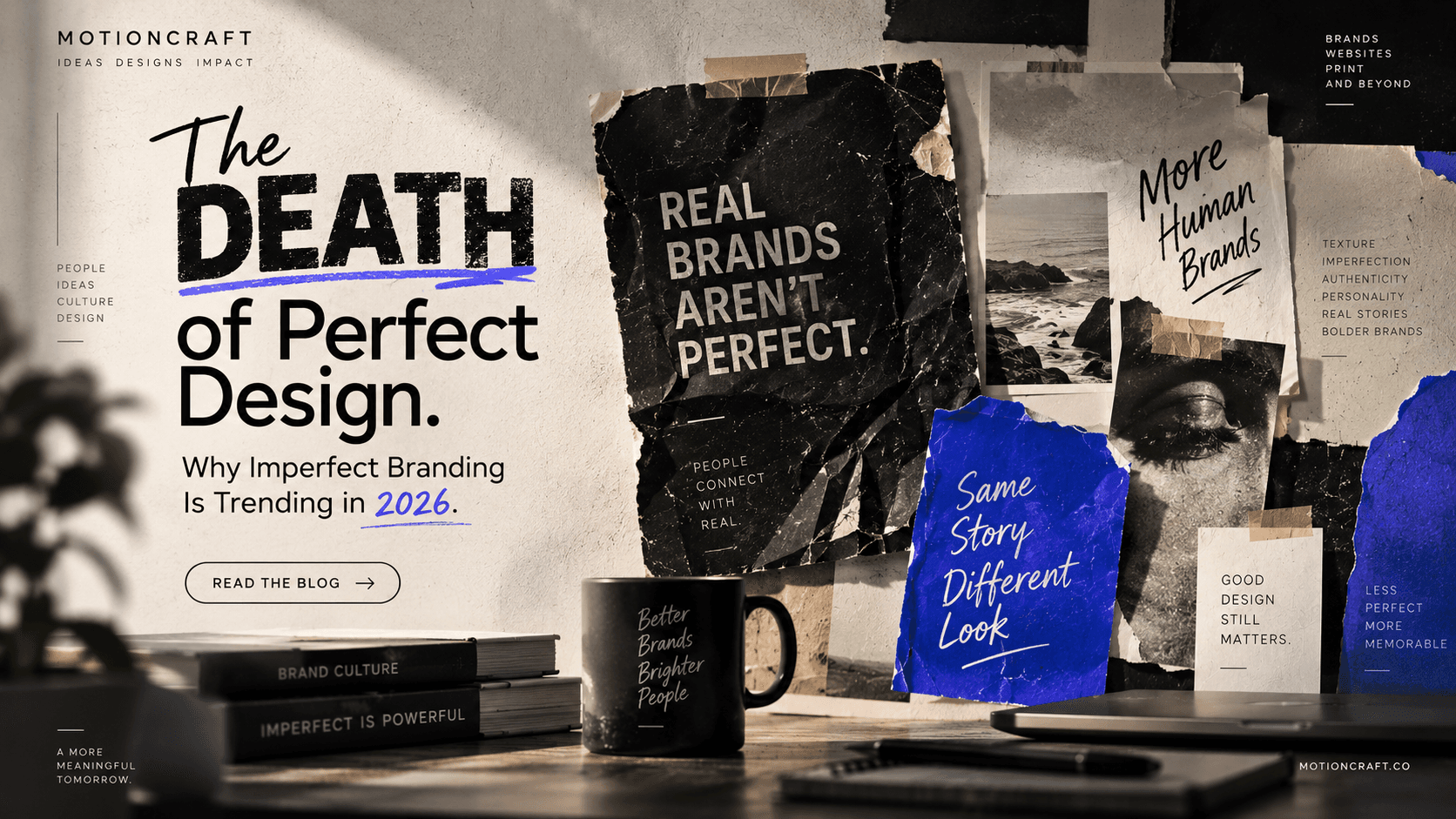
The Death of Perfect Design: Why Brands Are Embracing Imperfection
SEO title: The Death of Perfect Design: Branding Trends in 2026
Primary keyword: branding trends 2026
Related keywords: design trends 2026, imperfect design, authentic branding, visual identity trends, graphic design trends, human-centred design, brand design
Meta description: Perfect branding is losing some of its appeal. Discover why texture, raw photography, irregular typography and human imperfection are shaping design trends in 2026.
For years, digital design chased perfection.
Perfect grids.
Perfect spacing.
Perfect product photography.
Perfect gradients.
Perfectly smooth illustrations.
And then AI arrived and made perfection incredibly easy.
Now something unexpected is happening.
Imperfection feels interesting again.
Canva named its overarching 2026 creative direction “Imperfect by Design,” reporting increased interest in tactile textures, DIY aesthetics, raw visual expression and cinematic storytelling. Searches for DIY and scrapbook-style elements on its platform rose 90% year over year.
Why?
Because when perfection becomes abundant, personality becomes scarce.
We may have reached peak polish
Look through enough modern brands and you'll notice the pattern.
Minimal wordmark.
Neutral background.
Sans-serif type.
Soft gradient.
Beautiful mockup.
Perfect photograph.
Tasteful animation.
There's nothing technically wrong with any of it.
But that's precisely the problem.
Nothing is wrong — and nothing is particularly memorable either.
Imperfection introduces evidence of a human being
Think about:
A handwritten annotation.
A torn-paper edge.
Film grain.
A slightly awkward crop.
A scanned texture.
An imperfect photograph.
Unexpected typography.
An illustration with visible brush strokes.
These elements introduce something digital perfection often removes:
evidence of the maker.
That's psychologically interesting.
We don't necessarily connect with imperfection because it's ugly.
We connect with it because it can feel specific.
This doesn't mean good design is becoming bad design
Intentional imperfection and careless execution are completely different things.
Bad alignment because nobody checked the layout isn't a trend.
Breaking a grid deliberately because it creates tension can be a design decision.
The key word is:
intentional.
Good designers know the rules.
Great designers know when breaking one makes the work stronger.
AI is accelerating the reaction
Generative AI can create extremely polished imagery at enormous speed.
That makes polish itself less distinctive.
The interesting question becomes:
If anyone can generate a flawless image, what does flawless communicate?
Sometimes the answer is: not much.
This may explain why analogue textures, imperfect typography, documentary photography and tactile design are reappearing alongside increasingly powerful AI tools.
Technology advances.
Culture reacts.
Design moves again.
Authentic branding doesn't mean deliberately making things ugly
There's another trap here.
Brands will inevitably see “imperfection” trending and start adding random grain, scribbles and torn paper everywhere.
That's not authenticity.
That's another template.
The visual treatment should come from the brand.
A heritage coffee company might use print textures.
A rebellious fashion label might use rough typography.
A financial technology company might require something considerably more controlled.
The objective isn't:
Make it imperfect.
It's:
Make it recognisable.
Perfect design isn't actually dying
And this is the important nuance.
Canva is simultaneously seeing demand for stripped-back simplicity: searches for “clean layout,” “serif” and “simple branding” rose 54% year over year on its platform.
So this isn't minimalism versus maximalism.
It's something more interesting.
We're moving away from default aesthetics.
A brand can be beautifully minimal.
Or wonderfully chaotic.
What matters is whether that decision belongs to the brand.
Motion Craft perspective
The future isn't imperfect design.
It's intentional design with personality.
If every element is perfect but nothing feels like you, perfection isn't solving the branding problem.
Build a more distinctive visual identity with Motion Craft →