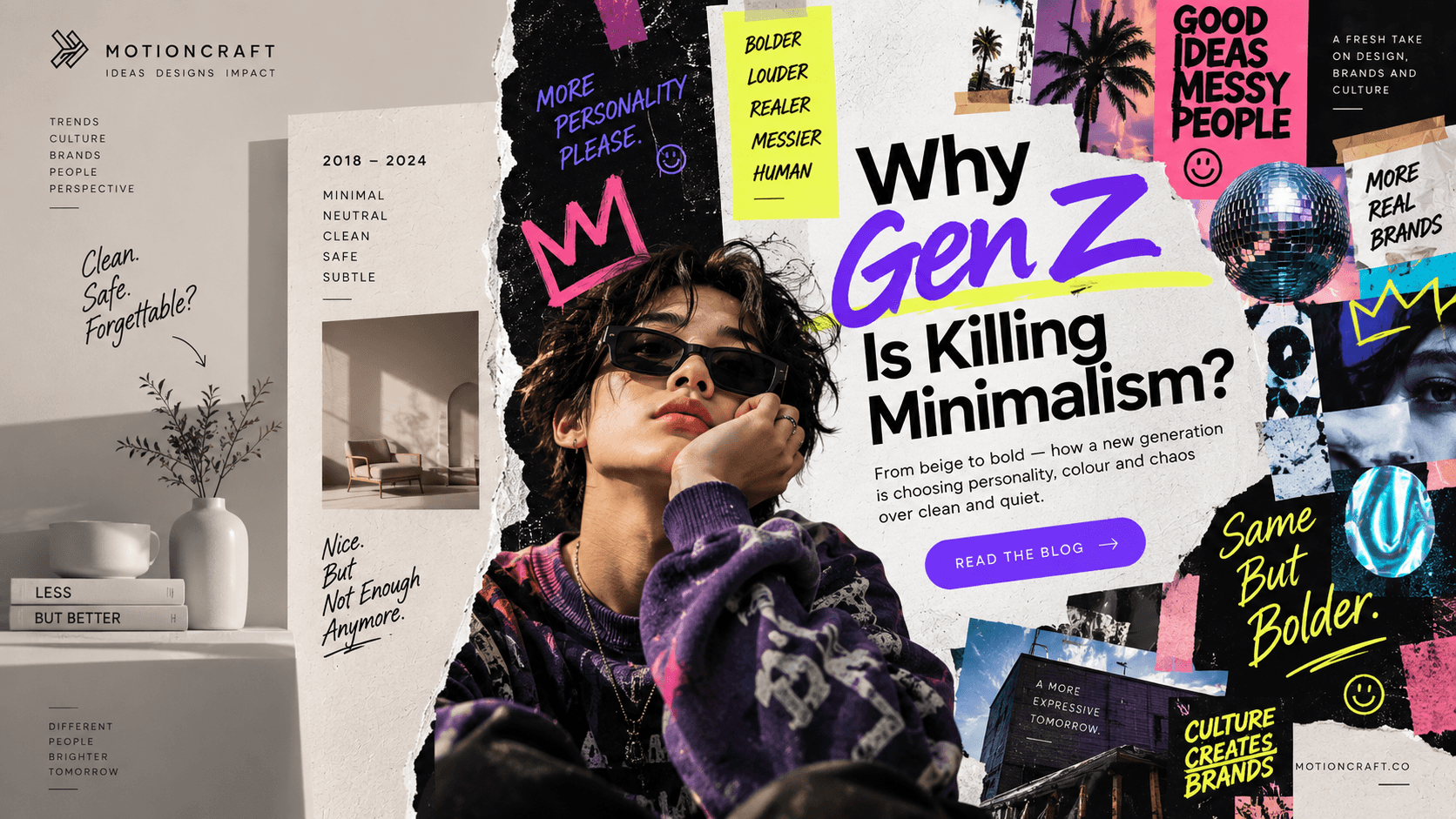
Why Gen Z Is Killing Minimalism
SEO title: Is Gen Z Killing Minimalism? The Rise of Maximalist Design in 2026
Primary keyword: maximalist design
Related keywords: Gen Z design trends, design trends 2026, maximalism, minimalism, branding trends 2026, graphic design trends, Gen Z branding, visual identity trends
Meta description: Is minimalism dying? Explore why Gen Z branding is embracing colour, texture, nostalgia, bold typography and maximalist design — and why minimalism isn't actually going away.
Beige had a very good decade.
Neutral colours.
Sans-serif fonts.
White space.
Simple logos.
Clean product photography.
Muted interiors.
Minimal interfaces.
For years, the dominant visual message was:
Less is more.
Now a younger generation seems increasingly interested in asking:
Why not more?
Bold typography.
Colour.
Texture.
Collage.
Nostalgia.
Stickers.
Illustration.
Chaos.
Personality.
Welcome to the return of maximalist design.
Why did everything become minimal?
Minimalism wasn't an accident.
It works extremely well digitally.
Simple interfaces are easier to navigate.
Simple logos adapt to small screens.
Neutral design can communicate sophistication.
Minimal systems scale.
Companies such as technology startups naturally gravitated toward clean visual identities.
Then everybody copied everybody.
Eventually minimalism stopped being one particular aesthetic choice and became the default.
And defaults eventually create countercultures.
Gen Z grew up inside polished digital culture
This context matters.
Gen Z didn't discover the internet.
They grew up surrounded by it.
Perfect feeds.
Perfect influencer photography.
Perfect startup websites.
Perfectly curated lifestyles.
When polish becomes normal, roughness becomes interesting.
When minimalism becomes normal, maximalism becomes expressive.
Canva's 2026 trend research reflects this broader movement toward tactile, expressive and culturally specific aesthetics. In India, for example, Canva reports increased interest in heritage-inspired maximalism, with searches for "Desi" and "Hindi Typography" up 26% and 17% respectively year over year on its platform.
Maximalism gives brands more vocabulary
Minimalist identity might rely heavily on:
Typography.
Whitespace.
Photography.
Colour restraint.
Maximalism introduces more ingredients:
Patterns.
Illustration.
Textures.
Symbols.
Stickers.
Multiple typefaces.
Unexpected composition.
Cultural references.
Nostalgia.
Motion.
That creates opportunities for personality.
But it also creates opportunities for disaster.
Maximalism isn't "put everything everywhere"
Good maximalism still requires hierarchy.
Perhaps even more hierarchy than minimalism.
If everything screams, nothing is loud.
Successful maximalist design still guides attention.
There is still:
A focal point.
A hierarchy.
Contrast.
Rhythm.
Composition.
The visual language may be chaotic.
The design thinking underneath it shouldn't be.
Is minimalism actually dying?
No.
And that's where the headline becomes more interesting.
Canva's 2026 data shows another movement happening simultaneously: its "Opt-Out Era" trend is associated with restrained palettes, serif typography and structured editorial layouts. Searches around clean layouts and simple branding also increased on its platform.
Figma likewise lists both maximalism and other contrasting approaches among 2026 web-design directions.
So we're not moving from:
Minimalism → Maximalism
We're moving from:
One dominant aesthetic → Many competing aesthetics.
And that's healthier.
What does this mean for brands?
Don't become maximalist because Gen Z likes colourful graphics.
Don't become minimalist because your competitor uses Helvetica.
Start somewhere else:
Who are we?
Who are we speaking to?
What should people feel?
A financial advisory company and an independent music festival probably shouldn't share the same visual language.
Trend reports can tell you what culture is doing.
Brand strategy tells you what you should do.
Personality is becoming valuable again
Perhaps that's the real story.
Not maximalism.
Not minimalism.
Personality.
Brands are rediscovering:
Cultural references.
Local identity.
Humour.
Human photography.
Distinctive typography.
Illustration.
Unexpected colours.
Visual storytelling.
Not because every brand needs to become louder.
Because every brand needs a reason to be remembered.
Motion Craft perspective
Gen Z isn't killing minimalism.
Generic branding is becoming easier to ignore.
Minimalism can still be powerful.
Maximalism can be powerful.
The question isn't:
"Which style is trending?"
It's:
"Which visual language could unmistakably belong to us?"
That's where branding gets interesting.
Find your visual language with Motion Craft →