Most bad website projects were predictable at the sales call. The warning signs were there — vague answers on who does the work, no written scope, no plan for after launch — and got waved past because the pitch looked good.
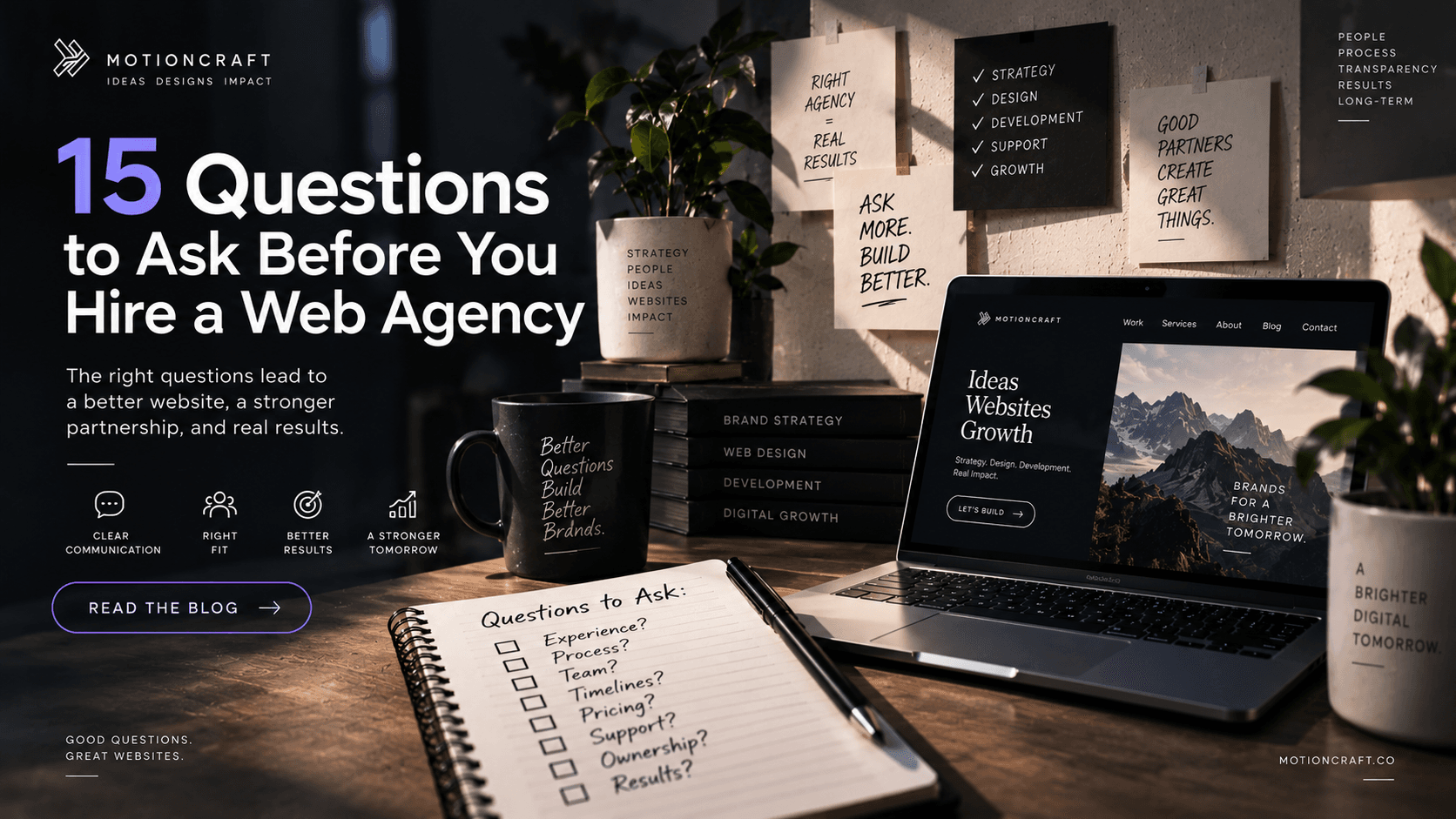
Here are the questions worth asking, grouped by what they protect you from. Ask them of any studio you're considering, including us.
Experience and fit
1. Have you built something like this before? Not "a website" — something with your kind of complexity, in a similar industry or business model. An e-commerce specialist and a B2B-lead-gen specialist are different studios.
2. Can I see live sites you've built, and talk to those clients? A portfolio of launch screenshots isn't the same as a reference who'll tell you what the project was actually like.
Team and communication
3. Who will actually do the design and development — and can I meet them? Some studios pitch with senior people and hand the work to juniors. You want to know who's on your project.
4. Who is my day-to-day contact, and how do we communicate? One named person, a predictable rhythm (weekly call, shared board), not a black box.
5. Is any of this outsourced? Not necessarily a dealbreaker, but you should know if part of your build is going to a third party you can't talk to.
Pricing
6. Is this a fixed quote or an estimate? A fixed quote against a written scope protects you from the number doubling halfway through. If it's hourly, ask for a not-to-exceed cap.
7. What exactly is included? Design, development, hosting setup, domain, content migration, revision rounds, integrations, analytics, launch support — get it itemised. The gaps are where surprise invoices come from.
8. What's not included? Usually: copywriting, photography, ongoing maintenance, and anything discovered mid-project that wasn't in scope. Know this now.
9. What are the payment terms? A deposit plus milestones is normal. Paying everything up front, or nothing until the end, both create bad incentives.
Process and timeline
10. How long will this take, and can I see the plan? A real schedule with milestones — discovery, design approval, build, testing, launch — not "about six weeks."
11. What do you need from me, and when? Content, feedback, approvals. Most projects that slip, slip because the client was the bottleneck and nobody said so early.
12. How many rounds of revisions? And what happens when you want changes beyond them.
Ownership and after launch
13. Do I own the code, the domain, and the hosting accounts? The answer should be an unambiguous yes, with everything transferred to you at the end. If a studio keeps you locked in, that's a business model, not a service.
14. What does support look like after launch? Is there a warranty period? A retainer option? What's the response time if something breaks?
15. How hard is it to move to a different agency later? A good answer describes a standard stack and clean documentation. A bad answer is defensive.
What good answers sound like
- Specific, not vague. "Three weeks for design, four for build, one for testing" beats "a couple of months."
- Comfortable with the ownership questions. A studio that does good work has no reason to lock you in.
- Honest about what's not included, and why.
- A named team you can actually speak to.
For what it's worth, here's how we answer these: fixed quote against a written scope before any work starts; one point of contact and a weekly review; the people on the call are the people who build it; and you leave with the code, the accounts, and documentation — no lock-in. See our services and selected work, or start a conversation.