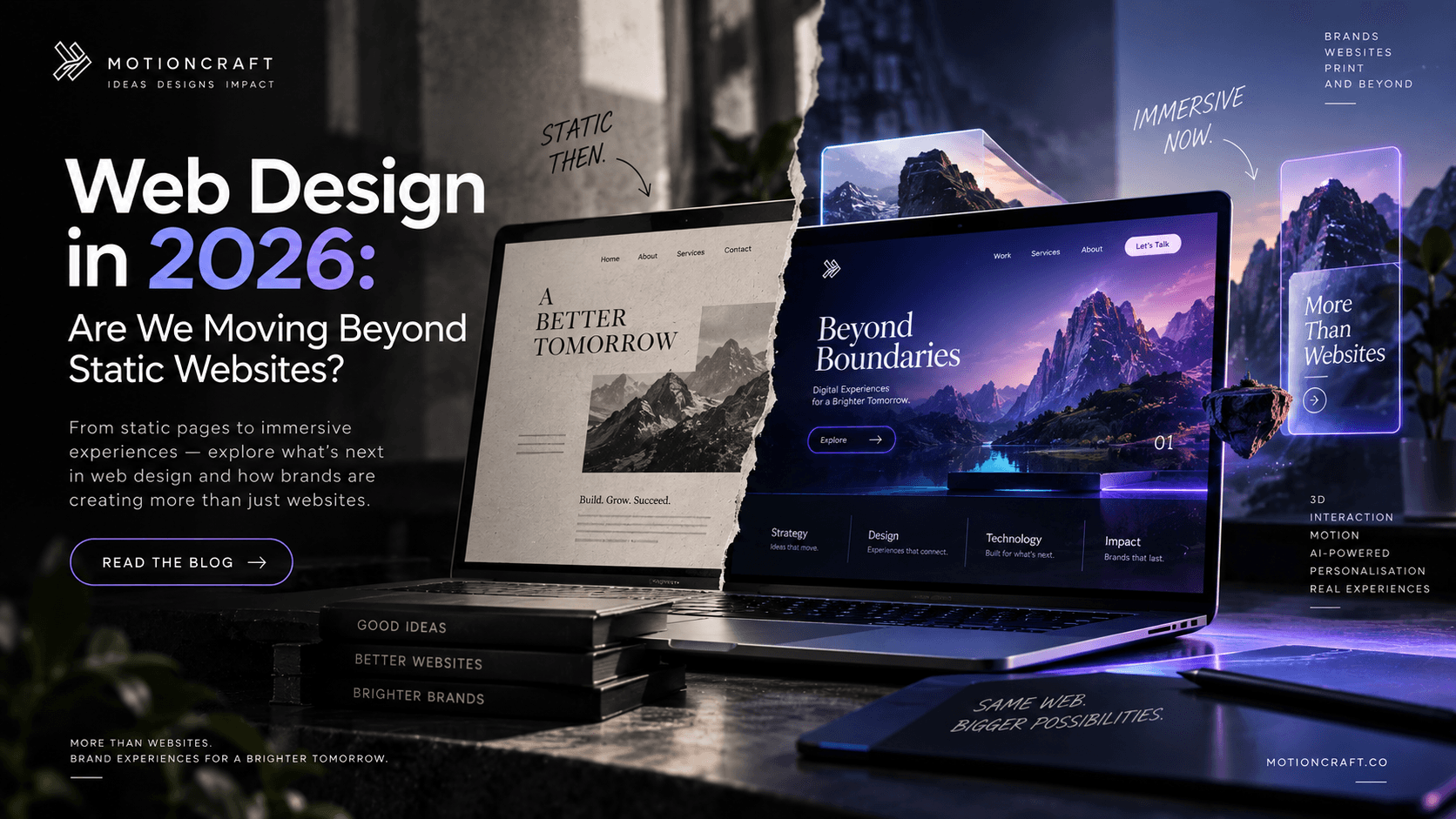
Are We Moving Beyond Static Websites?
SEO title: Web Design Trends 2026: Are Static Websites Becoming Obsolete?
Primary keyword: web design trends 2026
Related keywords: interactive website design, modern website design, motion design, 3D websites, immersive websites, AI website design, web development trends 2026
Meta description: Static websites aren't disappearing, but the web is becoming more interactive. Explore motion, 3D, AI, personalisation and the future of website experiences.
The website used to be a document.
You opened it.
You read it.
You clicked another page.
You read some more.
Maybe you filled in a contact form.
That model isn't disappearing.
But the web around it is changing.
Modern websites increasingly respond, move, personalise and behave.
Figma's 2026 web-design research highlights immersive 3D, experimental navigation, motion, maximalism and AI-driven experiences among prominent directions in contemporary web design.
So are static websites becoming obsolete?
Not exactly.
But our definition of a website is expanding.
From webpage to digital experience
Traditional website:
Read → Click → Read → Contact
Interactive website:
Explore → Interact → Discover → Respond
Imagine a property website where you explore a development in 3D.
A furniture website where you rotate the product.
A travel website where the page changes as you explore a destination.
A creative studio where scrolling becomes part of the narrative.
The website isn't simply displaying information anymore.
It's communicating through interaction.
Motion isn't decoration anymore
Animation used to be something added at the end.
Today, good motion can explain relationships.
A menu appearing from a particular location tells you where it belongs.
A card expanding into a page shows continuity.
A progress animation tells you the system is responding.
Figma's 2026 web-development overview describes this as functional motion: animation increasingly operates as part of interface structure rather than being merely decorative.
That's an important distinction.
3D is becoming practical
3D web experiences used to be associated primarily with experimental agency websites.
That's changing.
3D can have practical applications:
E-commerce: inspect a product.
Property: explore a building.
Automotive: configure a vehicle.
Education: interact with a model.
Tourism: preview an environment.
Product marketing: demonstrate how something works.
The question isn't whether 3D looks impressive.
It's whether 3D helps communicate something that 2D cannot.
AI could make websites adaptive
Here's where things become even more interesting.
Most websites currently show essentially the same homepage to everyone.
But imagine a website capable of understanding intent.
A first-time visitor might receive an introduction.
An existing customer might see support information.
A visitor from another country might see relevant content.
Someone researching a particular service could see information prioritised around that interest.
We move from:
Static → Interactive → Adaptive.
But don't turn your website into an amusement park
There's a danger whenever technology becomes fashionable.
Suddenly every website needs:
Parallax.
3D.
Cursor effects.
Scroll hijacking.
Video.
Transitions.
Particles.
AI chat.
And somehow nobody can find the contact button.
That's not innovation.
That's friction.
Sometimes a static website is exactly right
A local accountant probably doesn't need an immersive WebGL universe.
A restaurant may simply need:
Menu.
Location.
Opening times.
Reservations.
Photography.
A clear mobile experience.
The best technology is the technology that serves the objective.
Not the technology that wins the most Dribbble likes.
So what comes after static websites?
Not one thing.
We're moving toward a broader spectrum:
Informational websites
↓
Interactive websites
↓
Immersive experiences
↓
Personalised websites
↓
AI-assisted experiences
Different businesses belong at different points.
Motion Craft perspective
Don't ask:
"How futuristic can our website look?"
Ask:
"What can the website do that makes the customer's experience better?"
That's where modern web design becomes valuable.
Build a website experience with Motion Craft →