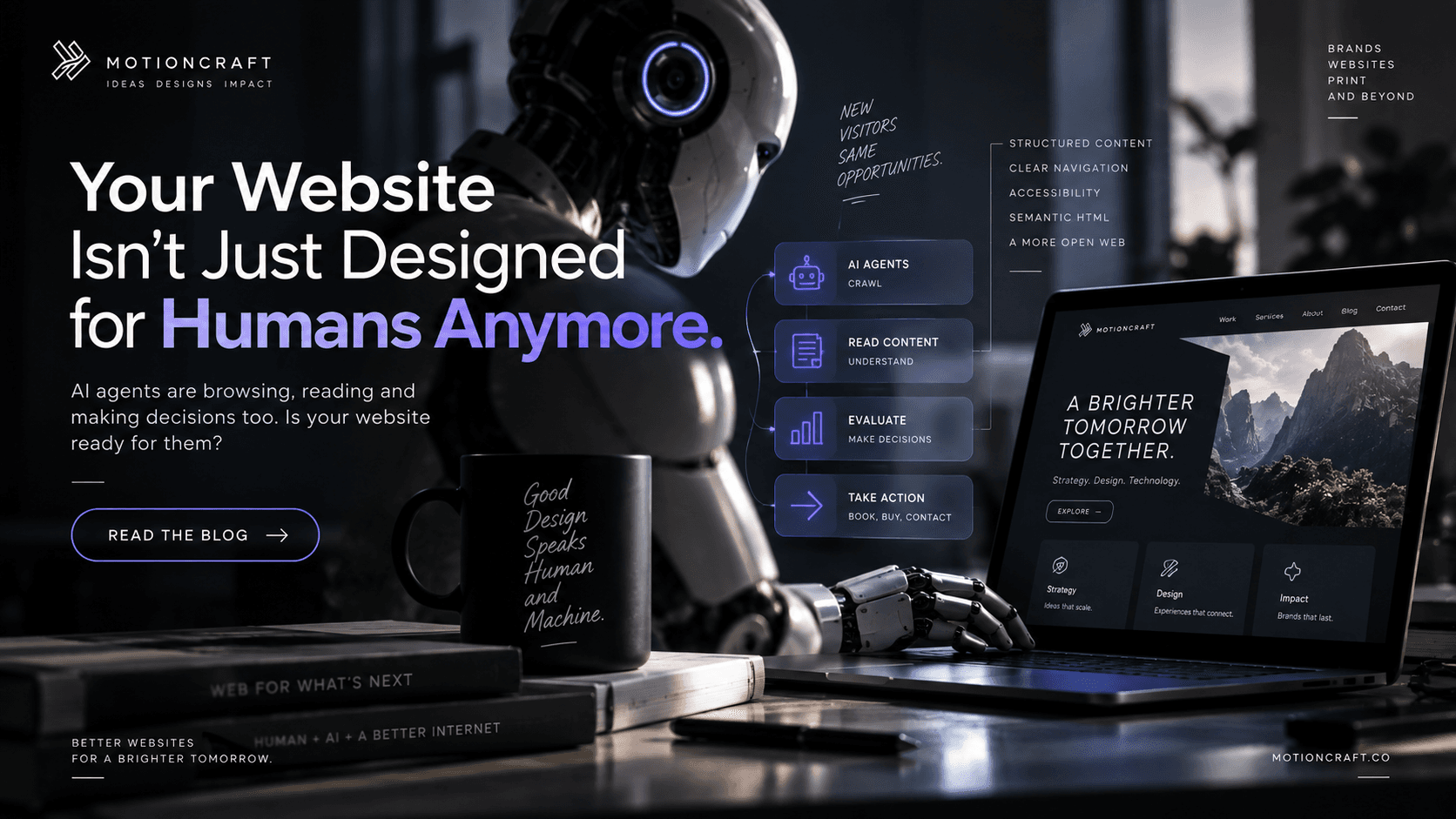
Your Website Isn't Just Designed for Humans Anymore
SEO title: AI and Web Design: Why Websites Aren't Just for Humans Anymore
Primary keyword: AI web design
Related keywords: AI website design, website structure, semantic HTML, structured data, AI agents, accessible web design, SEO website design, AI-friendly website
Meta description: AI agents are changing how websites are discovered and understood. Learn why structure, accessibility, content and machine-readable websites matter alongside great visual design.
Your website has always had invisible visitors.
Search-engine crawlers have been reading websites for decades.
But we're entering another phase.
AI systems increasingly summarise information, interpret pages and mediate how people discover businesses online.
That means your next website visitor might not initially experience your website visually at all.
It may first try to understand it.
The old website question was: "What will people see?"
Designers obsess over:
Hero sections.
Typography.
Photography.
Animation.
Colour.
Spacing.
And rightly so.
Humans experience websites visually.
But increasingly we also need to ask:
What does this page mean?
A beautiful page whose purpose is difficult to understand is still a weak interface.
AI makes structure more important, not less
Machines benefit from clarity.
Clear headings.
Logical page hierarchy.
Descriptive links.
Semantic HTML.
Structured information.
Accessible navigation.
Useful page titles.
Well-organised content.
These are not particularly glamorous topics.
But they create the foundation underneath the visual interface.
And interestingly, many of these principles already benefit another audience:
humans.
Accessibility, SEO and AI share an important idea
Clarity.
Consider a button saying:
Click Here
versus:
View Web Design Services
The second is more descriptive.
Consider a page containing visually styled text but poor HTML structure versus a page with logical headings and sections.
One may look identical to the user.
Underneath, they're very different documents.
This is why visual design and web development can't be completely separated.
Does this mean design becomes boring?
No.
In fact, the opposite.
The visual layer can become increasingly expressive while the structural layer becomes increasingly disciplined.
Think of it like architecture.
Visitors experience:
Materials.
Light.
Space.
Furniture.
Atmosphere.
But underneath that experience sits engineering.
A website works similarly.
Visual experience above.
Structured information underneath.
What should businesses do?
Don't redesign your website for robots.
Design it properly for everyone.
That means:
Make your purpose obvious
A visitor should understand what you do quickly.
Organise content logically
Your navigation shouldn't require detective work.
Use meaningful headings
Headings should describe actual sections rather than exist purely for styling.
Build accessible interfaces
Keyboard navigation, contrast, descriptive labels and sensible structure benefit more than AI.
Keep important information in actual content
Don't bury everything inside decorative graphics.
Think about structured information
Where appropriate, structured data can give machines additional context about content and entities.
Keep performance in mind
A visually impressive website that barely loads is not impressive.
AI isn't replacing UX
AI actually makes good UX principles more important.
Because whether the visitor is:
a person,
a search engine,
an assistant, or
an agent,
the fundamental question remains:
Can they understand what this website is trying to communicate?
Motion Craft perspective
The modern website needs two layers working together:
An experience humans want to explore.
A structure machines can understand.
Beautiful websites aren't enough anymore.
But ugly machine-readable websites aren't the answer either.
Good web design needs both.
Explore Web Design & Development at Motion Craft →