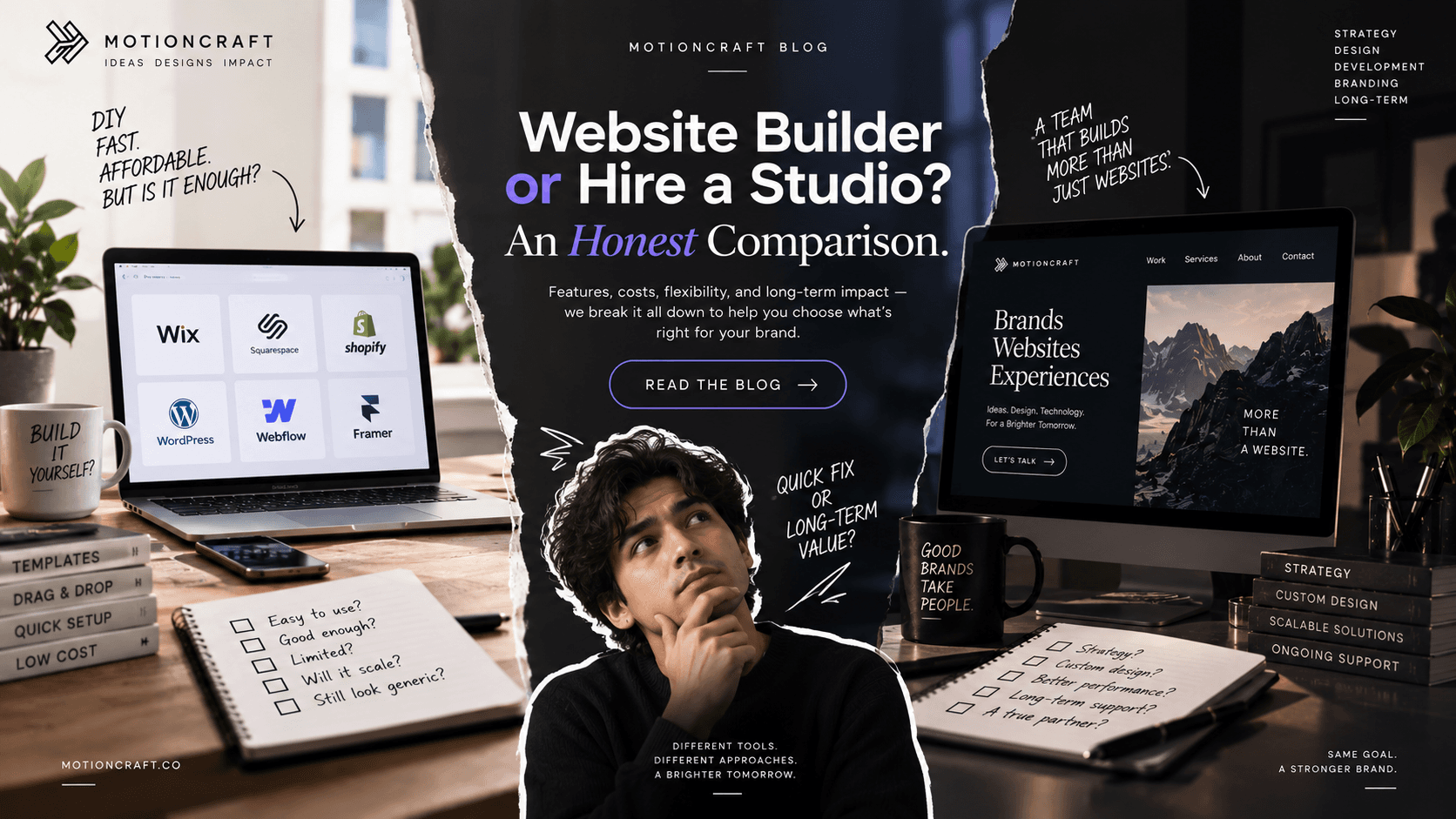
This is one of the most-searched questions by anyone about to spend money on a website, and most of the answers are written by people with something to sell — either a builder or an agency. So here's the version that tells you when the builder wins.
When a website builder is the right call
Use Wix, Squarespace, Shopify or similar if most of these are true:
- You need a handful of pages — home, about, services, contact — and the site's job is to exist and look credible, not to generate a steady stream of leads.
- Your budget is genuinely tight and the site isn't a revenue channel yet.
- You want to be live in days, and you're comfortable maintaining it yourself.
- Nothing unusual is required: no complex integrations, no multi-language, no custom booking or membership logic.
- You're testing an idea and might pivot — you don't want to invest in something you may throw away.
A local trades business, a new consultant, a restaurant that needs a menu and a map — a builder serves all of these well, and paying an agency several thousand for the same outcome would be a waste.
The economics are real: a builder is $17–$50 a month all in. If it does everything you need, it's far cheaper than design plus development.
Where builders stop being enough
The problems show up later, and they're specific:
You don't own it. Your content and design are locked to the platform. Outgrow Wix and you rebuild from scratch — you can't export the site and move it. That "cheap" start becomes an expensive migration.
Performance has a ceiling. Builders load a lot of code you didn't ask for. On a slow phone connection — common in a lot of the markets you might be selling to — that's a real problem, and it's one you can't fix from inside the builder. Google's Core Web Vitals are a ranking factor, and builder sites routinely struggle with them.
SEO tools are not SEO. "Built-in SEO" means the builder lets you edit a title tag. It doesn't mean structured data done right, a clean URL structure, proper international routing, or the technical foundation that lets you actually compete for a term.
Custom logic hits a wall. A booking system with your specific rules, a members area, a product configurator, an integration with your CRM or accounting tool — builders handle the common cases and fall over on anything bespoke. You end up bolting on third-party apps that each cost money and slow the site down.
Multi-country and multi-language is painful. If you sell in more than one market, builders make hreflang, per-market pricing, and translation workflows harder than they need to be.
The honest middle ground
You don't have to choose "cheap builder now" or "expensive custom build now." A sensible path for a growing business:
- Start on a builder if you're early and unsure. Get live, learn what your customers actually respond to.
- Move to a custom build when the site becomes a channel — when you can point to enquiries or sales it's driving, or should be driving. That's when the ceiling starts costing you more than the rebuild would.
- When you do move, own it. Get the code, the hosting accounts, and documentation, on a standard stack your team or any future developer can maintain.
If you're at that second point — the builder is holding you back and you can feel it — that's the conversation worth having. See how we build websites, look at what we've shipped, or tell us where the builder is falling short.