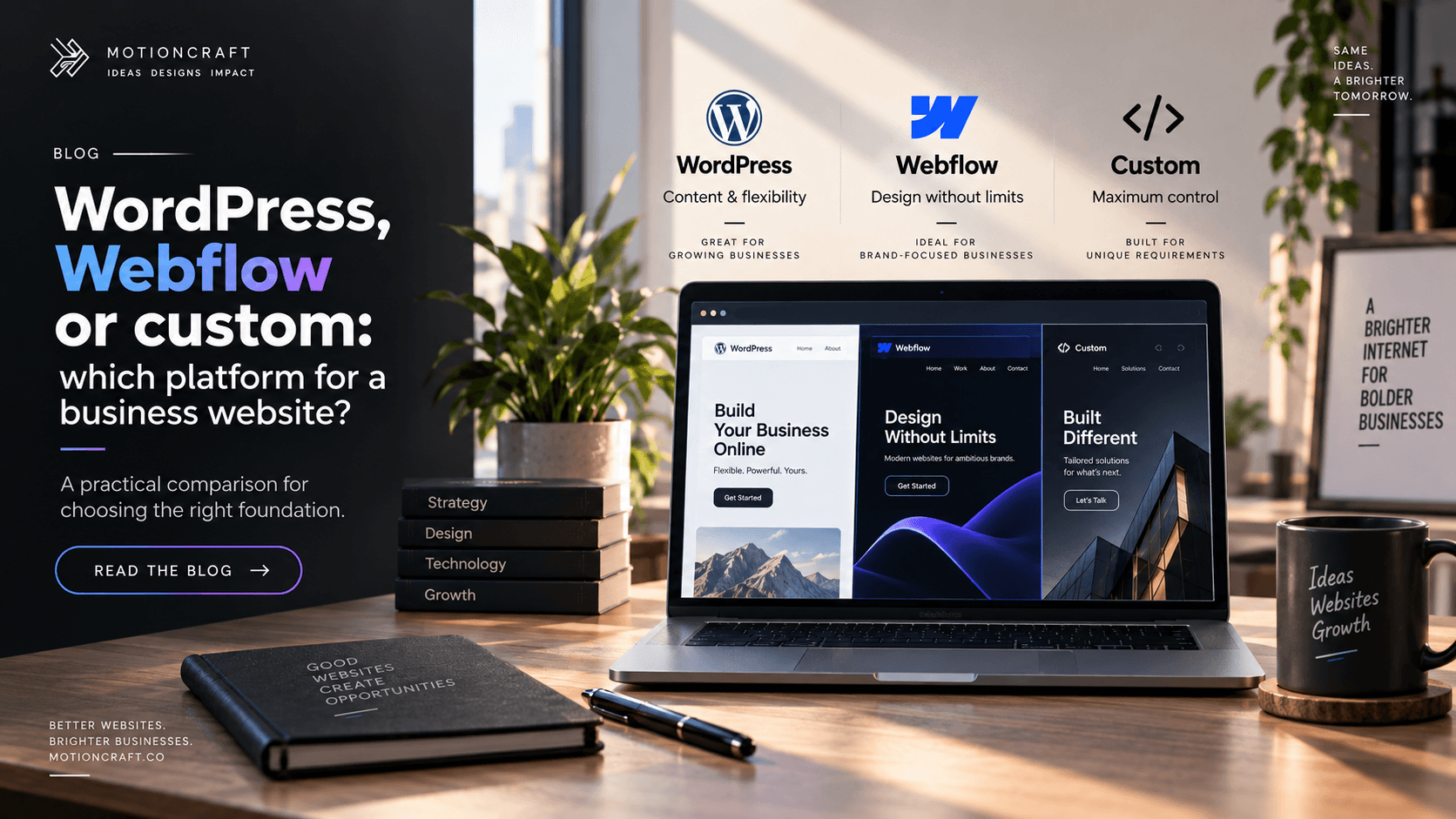
Every platform has a loud fan base and a list of reasons it's the best. That's not useful when you're choosing. The question that matters is narrower: which one fits how your business will actually run this site over the next three years?
WordPress
Still runs a huge share of the web, and for good reason: mature, endlessly extensible, and there's a plugin for everything.
Good fit when: you publish a lot of content and want a familiar editor; you need a specific plugin ecosystem (WooCommerce for shops, membership tools, etc.); you have someone who'll keep it maintained.
The catch: WordPress is a maintenance commitment. Core, theme and plugin updates need applying regularly or the site becomes a security risk. "A plugin for everything" also means a site can accumulate ten plugins that each slow it down and occasionally conflict. Left untended for a year, a WordPress site is usually a mess.
Webflow
A visual builder that produces reasonably clean sites, with a proper CMS. Popular with design-led small businesses.
Good fit when: design matters and you want to control it visually without a developer; your content needs are moderate; you're happy inside Webflow's editor and its pricing.
The catch: you're on Webflow's platform and its pricing, and moving off it later means a rebuild. Custom functionality beyond what Webflow offers means bolt-on tools or leaving. It's a middle option — more control than a simple builder, less than custom, with lock-in either way.
Custom (React / Next.js)
The site is built as an application on a standard modern stack, usually with a headless CMS for the content you edit yourself.
Good fit when: the site is a channel for the business — leads, sales, something people use; you need performance and SEO to be genuinely competitive; you have custom logic, integrations, or multi-language requirements; you want to own everything outright with no platform in the middle.
The catch: higher upfront cost, and you need a developer (or a studio on retainer) for structural changes — though day-to-day content editing goes through the CMS like any other platform. It's overkill for a simple brochure site.
The decision, simplified
Ask yourself:
- Who maintains this? If the answer is "nobody technical, and we won't pay for a retainer," avoid WordPress — it degrades without attention. A builder or Webflow is safer.
- Is design a differentiator or just table stakes? If your brand and craft are part of what you sell, custom or Webflow. If you just need to look credible, a builder is fine.
- Does the site need to do things — bookings, accounts, a configurator, CRM sync, multiple languages done properly? That pushes you toward custom; the others fight you on anything bespoke.
- How competitive is your search space? If you need to genuinely out-rank established competitors, the performance and technical control of a custom build is a real advantage. For low-competition local terms, any platform can rank.
There's no universally right answer — a five-page local business site on Webflow and a lead-generating platform on Next.js are both correct choices for their situation.
We build custom on React and Next.js because that's where the performance, SEO and ownership advantages are for the businesses we work with — but we'll tell you honestly if your project is better served by something simpler. See how we build or tell us about your project.