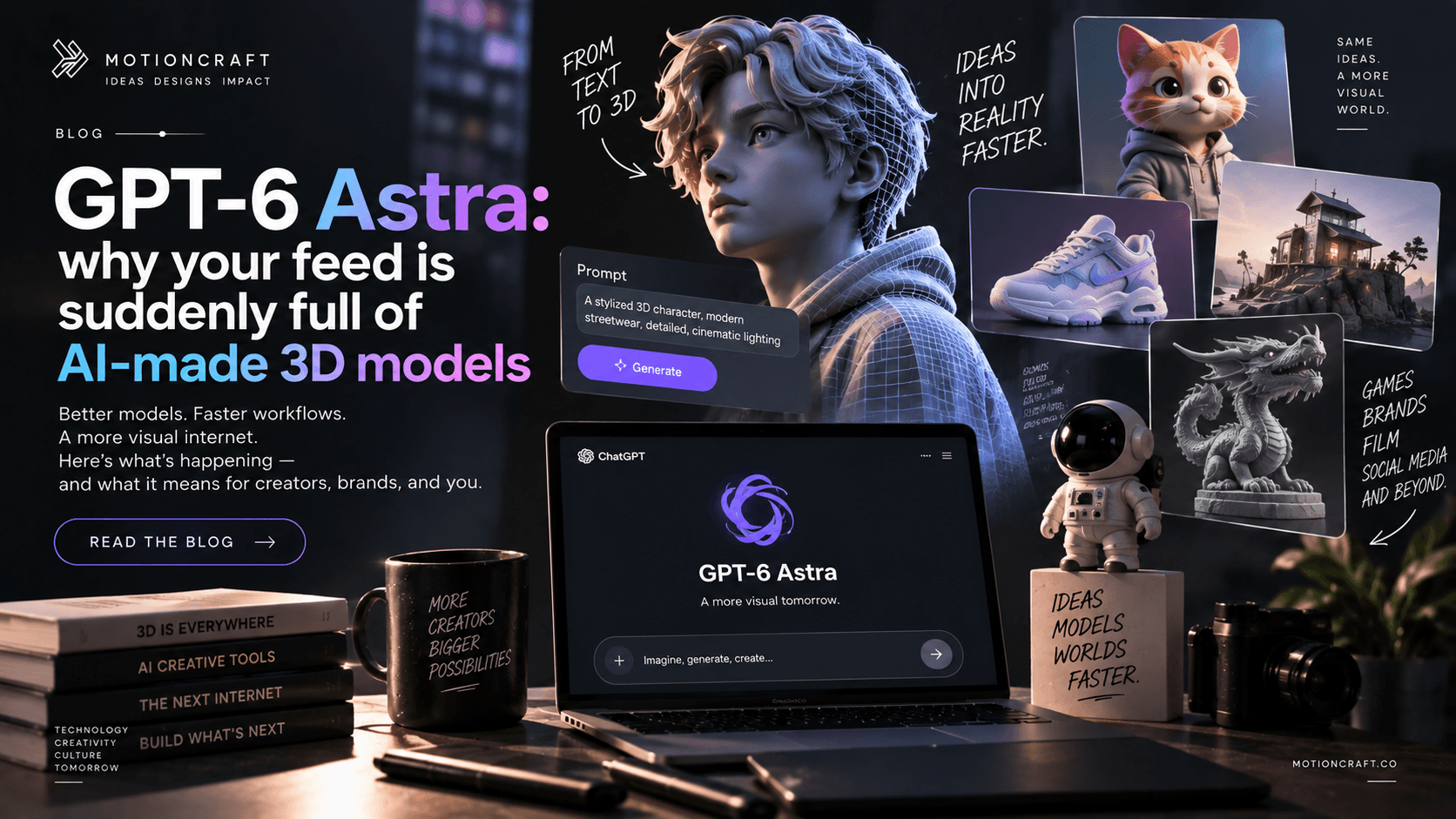
Short version: OpenAI released GPT-6 Astra on September 3, 2026. Unlike previous models that describe how to build something, Astra directly operates design software — it opens Blender, shapes geometry, adds materials, and hands back an editable 3D scene from a plain text description. That's why timelines are suddenly full of AI-made 3D renders: people are posting the model's output because it's the first version where the results look finished rather than obviously AI-generated.
If your feed has turned into a wall of photorealistic 3D objects and impossible little worlds this week, this is why.
What GPT-6 Astra actually does
Most "AI does 3D" stories over the past few years meant an AI generating a mesh from a prompt — usable as a rough starting point, rarely as a finished asset. Astra is different: it drives the software itself, the way a human artist would, inside applications like Blender. It opens the file, manipulates the scene, adjusts materials and lighting, and leaves you with a real, editable project rather than a locked-down export.
OpenAI's own announcement reports a geometric-overlap score of 95.9% on 3D-reconstruction benchmarks, against 83.3% for GPT-5.6 Sol and 84.3% for Claude Fable 5.1 — and at roughly 43% lower estimated API cost than Sol. Whatever you make of benchmark numbers generally, the practical result people are reacting to is simpler: the outputs hold up under a slow zoom instead of falling apart the way earlier AI 3D did.
The demos doing the rounds — a photorealistic bat, a working Game Boy model, full playable environments generated from photos — are why this spread so fast. It's a genuinely striking jump from what "AI 3D" looked like even a few months ago.
The pushback is worth hearing too
Professional 3D artists and Blender users have pushed back just as loudly: outputs still need real cleanup for production use, the workflow can get messy on anything non-trivial, and there's an obvious, uncomfortable question underneath the excitement about what this means for 3D-modeling work as a career. Both things are true at once — the leap is real, and "AI made a finished 3D model" is not the same claim as "AI made a production-ready 3D model."
What this actually means if you commission 3D or interactive work
- Concepting and pitches got much cheaper. Turning an idea into a 3D object or scene to react to, before committing real budget, is now close to instant. If you've been putting off visualizing a product or space because a first-pass render felt like overkill, that friction is mostly gone.
- Production-final assets still want a person. Client work, anything brand-critical, anything that has to be pixel- and polygon-perfect — that's still a human finishing pass on top of an AI starting point, not a straight swap.
- This lands squarely in "motion and interactive," not just "3D." The same wave that's producing static renders is also lowering the floor for the kind of CGI, product visualization and interactive web experiences we build motion and brand work around — including 3D and motion work on the web and the video and post-production side of a project.
The practical takeaway
Treat this the way you'd treat any sudden capability jump: useful for speed, not yet a replacement for judgment. If you're deciding whether an AI-assisted 3D pipeline is right for a specific brand or product visualization project, that's exactly the kind of call worth scoping properly rather than guessing from a demo reel — tell us what you're building and we'll give you a straight answer on what's genuinely ready to use today versus what still needs a human finishing pass.
See also: the 80s-style ChatGPT photo trend — a smaller but related moment in the same wave of AI image and creative tooling.