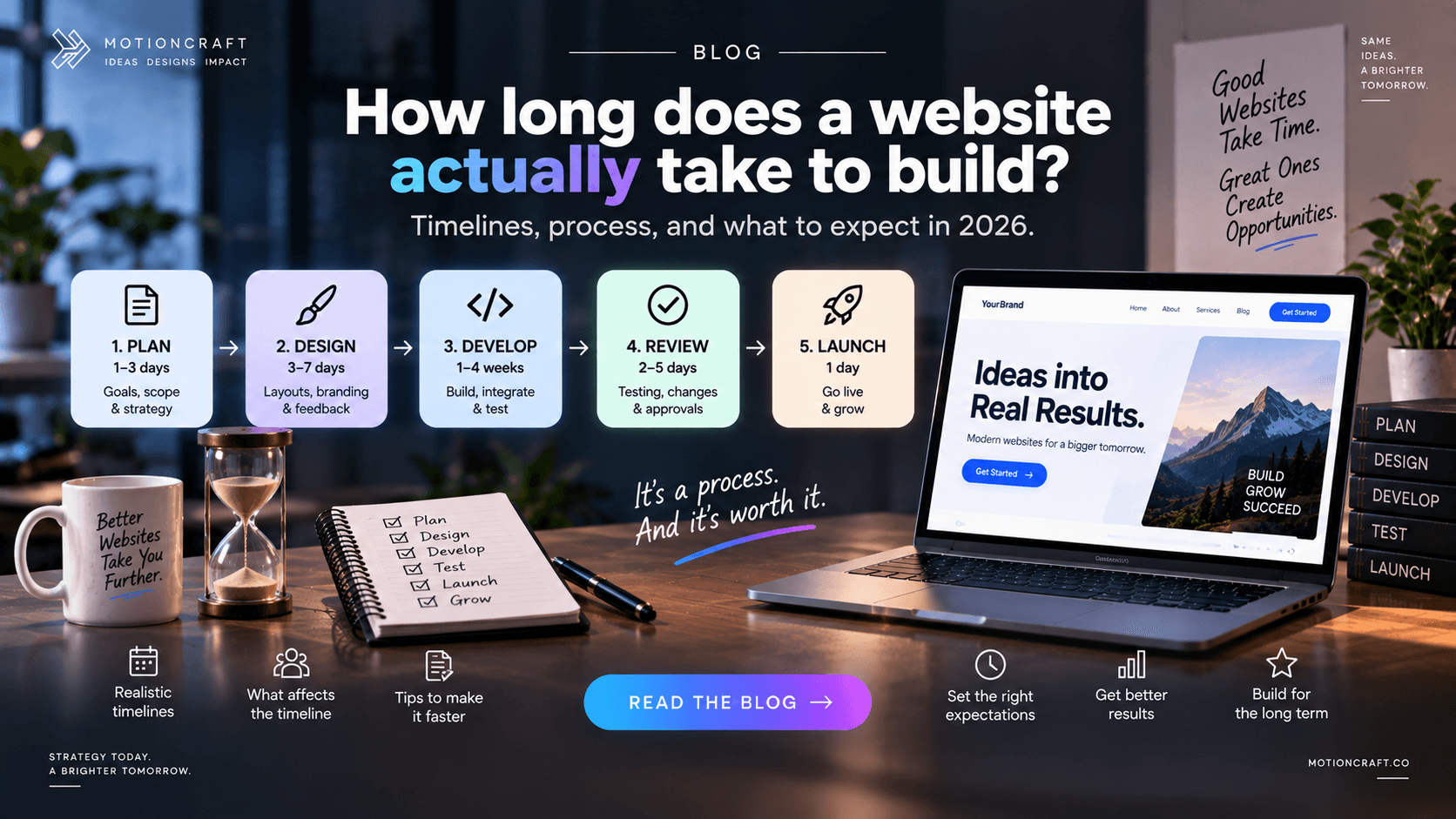
"About six weeks" is what most people are told, and it's true often enough to be useless. The honest answer depends on what you're building and — more than anything — on how quickly you can give feedback.
The realistic ranges
- A focused marketing site (5–12 pages, custom design, no complex functionality): 3 to 6 weeks from kickoff to launch.
- A content platform or larger site with a CMS your team runs: 6 to 10 weeks.
- A web application — anything with accounts, a dashboard, custom logic: 8 to 16 weeks, sometimes more.
- E-commerce: 8 to 14 weeks depending on catalogue size and how much is custom versus off-the-shelf.
- A multi-language site: add 2–4 weeks over the equivalent single-language build, mostly for the translation workflow.
If someone quotes you two weeks for a custom marketing site, they're either using a template with your logo dropped in, or the scope is much smaller than you're imagining. Neither is necessarily bad — just make sure you know which.
Where the weeks actually go
A typical marketing-site timeline:
Week 1 — Discovery. Understanding your audience, your market, and what the site needs to achieve. Agreeing on the sitemap and the one or two pages that carry the most weight. Nothing visual yet, and that's correct — design without this is decoration.
Weeks 2–3 — Design. The key pages first, in enough fidelity to react to. One or two rounds of feedback. This is where the project's character gets decided.
Weeks 3–5 — Build. Design and engineering overlap. You should see a working staging site by the end of this and be able to click around.
Week 5–6 — Content, testing, launch. Real content goes in, everything gets tested across devices and browsers, analytics and forms are wired up, and it goes live. A short buffer here is normal and healthy.
The thing that makes projects slip
It's almost never the studio. It's feedback latency.
A project planned around "we'll review the design and reply within two days" runs on schedule. A project where design feedback takes two weeks — because it needs three people to agree and one is on holiday — adds those weeks directly to the timeline, and there's nothing the studio can do about it.
Before you start, work out: who reviews and approves, how fast can they turn things around, and who breaks a tie. Projects with a single clear decision-maker finish on time. Projects run by committee don't.
What you're expected to provide, and when
- Content — the actual words and images. If the studio is writing copy, that's a separate workstream with its own timeline. If you are, have it ready before build, not during.
- Feedback — at the points the plan calls for it, in the format agreed (comments on the design, not a phone call where three contradictory opinions get raised).
- Approvals — a clear yes at each milestone so the next phase can start.
Ask to see the plan
Any studio should be able to give you a week-by-week schedule with named milestones — discovery done, design approved, build complete, testing, launch — not just an end date. If they can't, they don't have a process, and the timeline is a guess.
That's how we run projects: a fixed quote and a dated plan after discovery, so you always know what's happening this week. See how we work or tell us what you're building for a realistic timeline on your specific project.