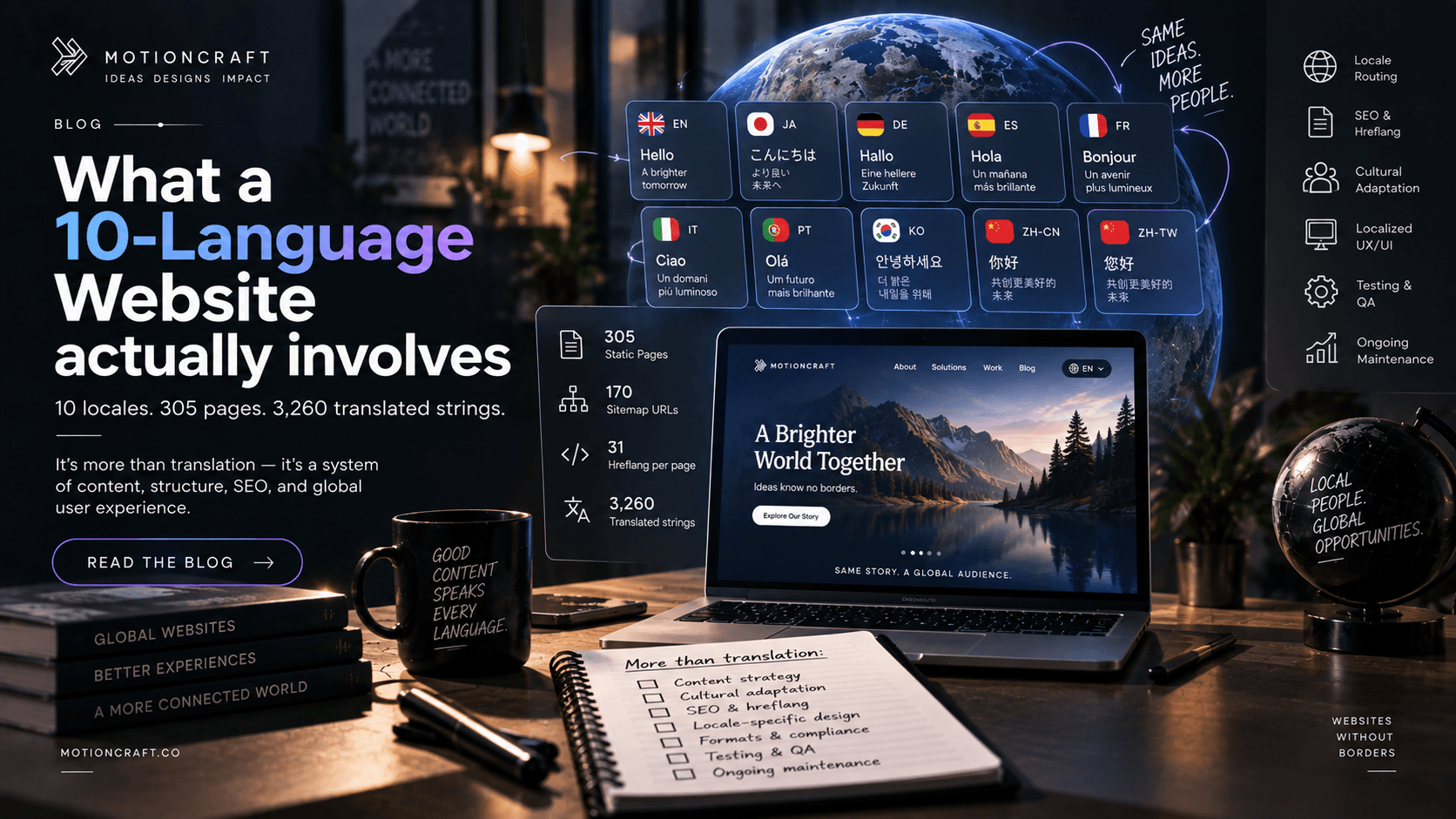
Short version: we rebuilt this site to run in 10 languages. The engineering is a one-time setup — routing, hreflang, locale detection. The ongoing work is translation quality and per-market SEO. Below are the actual numbers, because most writing on international websites is abstract and the specifics are what help you budget.
Most articles about building for multiple countries — including our own guide — talk in principles. This one is a teardown of a real system with every number attached: the site you're reading.
What "10 languages" means here
| Locale | Language | Primary market |
|---|---|---|
en |
English | UK, US, Canada, Australia, NZ, Ireland (one shared page) |
ja |
Japanese | Japan |
ko |
Korean | South Korea |
zh-TW |
Traditional Chinese | Taiwan |
it |
Italian | Italy |
de |
German | Germany, Austria, Switzerland |
es-ES |
Spanish (Spain) | Spain |
es-419 |
Spanish (Latin America) | Mexico, Argentina, Colombia, Chile… |
pt-PT |
Portuguese (Portugal) | Portugal |
pt-BR |
Portuguese (Brazil) | Brazil |
Six English-speaking countries share a single /en URL, placed in each country's results by hreflang alone — no duplicate pages. Spanish and Portuguese are each split into two genuinely different translations, because European and Latin-American variants differ enough in tone and vocabulary to matter for trust.
The numbers
- ~305 statically generated pages at the time of writing. Home, services (6 + index), work case studies (6 + index), blog, FAQ, and the not-found page — rendered once per locale at build time.
- ~170 URLs in the XML sitemap, each carrying its full
hreflangcluster. - 31
hreflangannotations on every page — one per language/region variant (includingen-GB,en-US,de-AT,de-CH,es-MX,es-419and so on) plusx-default. - ~3,260 translated strings — 326 per locale, split across a UI dictionary and a longer page-content dictionary.
- First-load JavaScript: 199 kB for the homepage, 126–131 kB for content pages. Adding locales added zero runtime weight — only the active locale's strings ship to the browser.
- Blog: English only for now. The other locales show a localised "no articles yet" state and their post URLs return 404 rather than a thin machine-translated page.
How locale gets chosen
No IP redirection. In order of priority:
- A
NEXT_LOCALEcookie, if the visitor has already chosen or been assigned one. - The browser's
Accept-Languageheader, matched to the closest supported locale. - A default (
en).
Bare es resolves to Latin-American Spanish and bare pt to Brazilian Portuguese — the larger audiences — while es-ES and pt-PT are served only to browsers that specifically ask for them. Every page is reachable directly by URL (/de/, /ja/blog), so search engines crawl every locale without ever being redirected.
The translation process
- Draft — first pass generated with an LLM, working from the English source dictionary.
- Fluency review — a structured second pass on all five non-English language families, fixing the predictable machine-translation errors: UI labels translated as full sentences, calqued idioms ("this path is not in motion" rendered literally), wrong register, and a dangling adjective used as a noun ("static" as an ad-creative type). About 35 corrections across the six original locales.
- Native sign-off — not yet done, and flagged as required before any paid campaign in a given market. This is the honest status: the translations are fluent and structurally correct, but a native speaker should read each one before it carries ad spend.
The point of the workflow is that steps 1 and 2 are cheap and fast, step 3 is targeted (you only pay for native review of markets you're about to invest in), and a sync process flags the other languages for update whenever the English source changes.
The one constraint we'd change
This site is on a .co.in domain. That's India's country-code TLD, and Google treats it as a strong signal that the whole site is for India. hreflang still disambiguates language for the other nine markets — a German searcher gets the German page — but it can't override the country signal. So the non-India markets sit under a lower ceiling than they would on a neutral .com or .co.
It's a deliberate trade-off: the domain was already established, migrating carries its own SEO cost and risk, and the India market is real. But if you're choosing a domain before going international, choose a generic TLD (.com, .co, .io) and use subdirectories. The ccTLD decision is the one that's genuinely hard to undo.
What this means for your project
- The engineering is a one-time cost. Routing, hreflang generation, locale negotiation, the dictionary system — build it once, correctly, and adding the eleventh language is a translation task, not an engineering one.
- Budget for translation quality, not hosting. Ten locales added no meaningful hosting cost. The real spend is the review workflow and per-market content.
- Don't machine-translate your blog. An empty localised blog with an honest "coming soon" beats 13 posts of untrusted auto-translation that a native reader bounces off.
- Decide the domain and the Spanish/Portuguese split before you build. Both are painful to change later.
If you're planning a multi-market site, start with the full guide, then tell us which markets you're targeting — international builds are one of the things we do most, and Ayurexim is a brand we took from a single market to international shipping.